
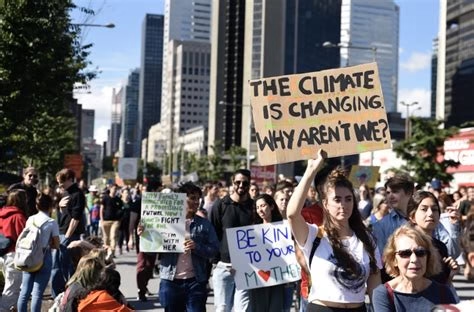
 It now looks as though Alberta’s premier Danielle Smith will get her new pipeline to the west coast.
On July 2nd, Prime Minister Mark Carney and Premier Smith announced a public/private partnership to construct the pipeline, which is estimated to cost between $35.2 billion and $43.7 billion. Up to 90% of the project will be publicly owned and financed, split between the Alberta and Canadian governments. The Alberta government is also advertising Indigenous co-ownership. It is currently expected that the remaining 10% will be financed and owned privately.
The proponents hope to start construction as early as 2027 and finish by 2034. The route will parallel the current Trans Mountain Pipeline to B.C.’s south coast. When completed, it will carry one million barrels per day of the world’s dirtiest oil – bitumen.
The pipeline announcement follows the May 15, 2026 announcement of an Implementation Agreement which more specifically outlines the commitments of both governments.
This one project alone will guarantee that Canada will fail to meet its carbon emissions reduction targets.
This one project alone will result in a massive increase in Alberta oil sands exploitation.
If ever there were something Canada, and for that matter humankind, does not need, it is another oil pipeline.
And not to be outdone, on July 6th the premiers of Alberta and Ontario announced plans to build a pipeline to transport an estimated 500,000 barrels per day of Alberta oil to refineries in southern Ontario. This proposal currently has no budget nor a timeline, and to date the premier of Manitoba has refused to participate. The proposal, as yet, has no federal backing.
If instead of investing in any more oil pipelines the federal government allocated the same amount of money to massively expanding renewable energy infrastructure and reducing Canada’s greenhouse gas emissions, just imagine for a moment the transformative effect.
We could replace all gas-and diesel-powered public transportation vehicles with electric alternatives.
We could retrofit all Canadian homes, making them more energy efficient.
We could offer significant incentives to anybody who replaced their internal combustion vehicle with an electric one.
We would be an environmental example for the rest of the world.
Instead, we are an example of what is moving the planet closer and closer to environmental Armageddon. Across our country, signs of the climate crisis are apparent, with extreme weather becoming more common, leading to heat waves, cold waves, droughts, and severe storms:
- Heat waves in Canada are becoming more frequent and more intense, and Canada is warming faster than anywhere else on earth. We increasingly have to regularly deal with summer wildfires across the country, exacerbated by equal increases in lightening strikes and dry vegetation. In 2021, the town of Lytton burned to the ground, while in 2024, much of Jasper, Alberta was also destroyed by wildfire. Across the country, residents are regularly forced to evacuate their homes, and to hope against hope that they will return to undamaged dwellings.
Extreme heat continues to hit not just our continent but much of the world. Already this summer, Europeans have sweltered under abnormally high temperatures – a scenario reminiscent of B.C.’s 2021 heat dome, which caused 689 deaths.
In Canada, our increasingly high temperatures are also causing more and more tornados to threaten residents and infrastructure. According to the Weather Network, Canada is now the world’s second-most-tornado-prone country.
- Flooding in Canada, brought on by climate change, is increasing. Flooding is reported to be the most common and costly disaster in Canada, threatening infrastructure, and populations with injury and death, degraded drinking water, and waterborne disease outbreaks. According to insurance analysts, our country has experienced five billion-dollar-plus flood events since 2011, while Public Safety Canada noted in 2022 that 80% of Canadian cities are wholly or partially built on floodplains.
- Canada has been known for years as a country of winter. In fact, we have one of the world’s most severe winter climates. Now, given climate change, extreme cold and massive snowfalls are becoming more common. The Weather Network has characterized the 2025-26 snowfall season as historic, with multiple cities receiving more than 500 cm. On the other hand, Vancouver and environs received no snow at all last winter, and much of B.C. now faces drought conditions.
Unless government priorities drastically change, the escalating climate calamities our world is facing will only intensify. Heat, drought, and fires will turn once-fertile land to deserts. Famines will become more common. As glaciers melt, sea levels will rise and coastal areas will flood.
Our world is on the verge of runaway climate change – we are reaching the point of no return.
Daily atmospheric CO2 [Courtesy of CO2.Earth]
Latest daily total (July 06, 2026): 429.97ppm
One year ago (July 06, 2025): 428.49ppm
Subscribe to Tim Louis
Keep up to date Tim's latest posts.