
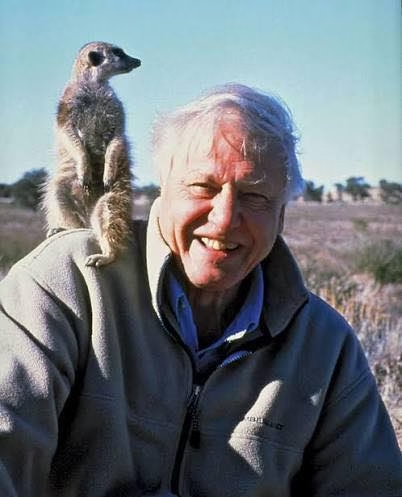
 On May 8,2026, one of my biggest heroes, David Attenborough, turned 100 years of age.
David Attenborough has made an unparalleled contribution to raising public awareness and awe of the spectacular beauty and versatility of nature. His documentaries are experiences one never forgets.
It is virtually impossible to fully chronicle all of Attenborough’s accomplishments. He spent much of his early career working with Britian’s BBC, including a number of years managing BBC Two.
During that time, he commissioned numerous programs and series which gained international acclaim. These included Civilisation, presented by Sir Kenneth Clark, Jacob Bronowski‘s The Ascent of Man, and fan favourite Monty Python’s Flying Circus.
Less known is that he was also instrumental in changing the colour of tennis balls to yellow, as the white ones were not easily seen on colour television.
As time went by, Attenborough’s focus turned more and more to bringing the world of nature into homes around the globe, starting with Life on Earth in 1979. Other celebrated series were The Living Planet, The Blue Planet, Great Barrier Reef, and Prehistoric Planet. A full list of his many broadcasts can be found in the Wikipedia article which chronicles his life. The BBC has also listed what is calls his ten best documentaries.
He is equally celebrated as a scientist, with a remarkable over 40 species named after him, including frogs, plants, insects and a constellation. In 2015 at age 89, he took a record-breaking 1,000-foot dive in a submersible to film parts of the Great Barrier reef.
In recent times, Attenborough has been ringing alarm bells about climate change and the perilous track we are currently on. His warnings have become more and more dire:
- His 2011 series Frozen Planet demonstrated how climate change was affecting our Earth and its animals, including disturbing warnings about the accumulating effects of rising temperatures and melting glaciers on people and wildlife.
- In Blue Planet II in 2017, he demonstrated how plastic pollution was contaminating the ocean, harming and killing birds and sea mammals.
- He followed up in 2025 with the film Ocean, which furthered his stress on the crucial importance of oceans to our climate and our world.
For many years now, Attenborough has advocated the benefits of reducing meat consumption for our health and the health of our planet. I share his concerns. In my late teens, I read Diet for a Small Planet by Frances Moore Lappé. The author made such a compelling argument in favour of not eating meat that I have not done so since reading her masterpiece.
I could continue writing at length about Attenborough, but the only way to truly appreciate this remarkable man is to watch his inspirational work. YouTube is a great place to start — https://www.youtube.com/results?search_query=david+attenborough. A number of streaming services also feature his documentaries, so check your subscriptions.
You should definitely check out his heartfelt warning at COP26 about the urgent need for action on climate change. We ignore his words at our peril.
We can all make our world so much better if we learn from David Attenborough’s century of exploration and take his advice to heart:
Lower your carbon and environmental footprint. Reduce. Reuse. Recycle.
Live simply so that others can simply live.
Daily atmospheric CO2 [Courtesy of CO2.Earth]
Latest daily total (May 14, 2026): 431.82ppm
One year ago (May 14, 2025): 430.69ppm
Subscribe to Tim Louis
Keep up to date Tim's latest posts.